
Keynote Speakers
Innovators Driving the Future of Project Management
We are excited to announce the Keynote Presenters:
Youssef Mourra is an experienced consultant, trainer, and presenter with expertise in portfolio, programme, and project management. He has delivered training worldwide, helping organisations achieve their strategic goals. Known for turning complex topics into accessible learning, Youssef works with all levels, from staff to board members, across various sectors and countries. He has developed a great reputation for training and presenting material in a manner that many people find engaging and occasionally entertaining.


Damon Kelly is the Founder and CEO of Enlighten Designs, a technology services leader known for pioneering AI-driven digital solutions and transformative customer experiences. With a deep passion for people, business, and technology, Damon founded Enlighten in 1998, not in a Silicon Valley garage but uniquely in a caravan in his New Zealand backyard.
Under Damon’s visionary leadership, Enlighten Designs has evolved into a cutting-edge technology partner, blending creativity, strategic thinking, and advanced AI capabilities. Damon champions using artificial intelligence to drive meaningful business innovation, frequently sharing insights and expertise online and at conferences as a recognized thought leader on the future of AI in enterprise settings.
Our keynote sessions will challenge assumptions, explore innovation, and inspire new thinking in project management practice and research.
Industry Discussion Panel
Artificial Intelligence and the Future of Technology Project Management: Transforming Work, Leadership, Practices, Organisational Structure and Roles
We are excited to announce the Industry Discussion Panelists:
Your Attractive Heading
Rachel Coxhead
The Group Services Lead Administrator at the University of Auckland, an AUT alumna, who was the winner of the Babcock Women in Technology Cup in 2023. She is a recent graduate from AUT (2023), kicking off her career as a Software Developer, also with an earlier background in Mathematics and Physics from the University of Auckland.
https://www.linkedin.com/in/rachel-coxhead/


Raymond Kwok
Senior Delivery LeadSenior Delivery Lead, Sourced Group and PMI NZ Auckland Co-Lead
https://www.linkedin.com/in/raymondmskwok/
Youssef Mourra
Founder, Principal P3M Consultant
Nonsuch
https://www.linkedin.com/in/youssefmourra/

Damon Kelly
Founder and CEO
Enlighten Designs
https://www.linkedin.com/in/damonkellyenlighten
Concurrent Session Speakers
People, Teams, AI and Leadership Track
The Environmental, Social, and Governance Leadership Gap: Why Women Project Managers Are Essential for Sustainability Success

Dr Olga Lozova
Abstract
Organizations often fail to translate Environmental, Social, and Governance (ESG) commitments into measurable outcomes. Despite significant investment, ESG initiatives often fail, greenwashing occurs, and stakeholders remain sceptical. This paper argues the root cause is not poor frameworks or lack of commitment, but a mismatch between project leadership capabilities and ESG demands. ESG projects involve three key paradoxes: temporal conflicts between short-term returns and long-term outcomes, integrity conflicts between compliance and genuine transformation, and cultural conflicts between global standards and local contexts. Addressing these requires integrative thinking, stakeholder coordination, and cultural bridging — skills women project managers frequently demonstrate. Drawing on organizational paradox theory, gender and leadership research, and New Zealand’s climate reporting context, this paper shows that closing the ESG gap relies on strategically deploying women in project management. While board-level research provides support, this analysis extends the insights to project-level ESG implementation and develops practical frameworks for both organizations and project managers.
An Investigation of Teamwork in the Era of AI

Thatiane Palumbo Ascar and Stephen Thorpe
Abstract
Artificial Intelligence (AI) is playing an increasingly transformative role in reshaping conventional teamwork practices such as feedback processes, resource allocation, reporting, action tracking, communication and collaboration. To examine the emerging dynamics of AI-mediated teamwork in the IT sector, a study was undertaken to identify the challenges and opportunities faced by IT teams. A survey of 41 IT professionals, who had experience using AI tools in collaborative contexts, gathered both quantitative and qualitative insights into their perceptions and practices. Findings suggest that AI is redefining core measures of team performance, enhancing productivity, improving efficiency, and strengthening some aspects of team cohesion. Key dimensions of AI-enabled collaboration included intelligent task distribution, automated communication support, and the application of data analytics to strategic decision-making. The study offers valuable guidance for both practitioners and scholars.
The IT Project Manager: Benefits of a Technical Skill Set
Livia Krstic and Stephen Thorpe
Abstract
There are internationally recognised frameworks and accreditation that identify the important skills needed of an IT project manager. It has been anecdotally recognised that technical skills for an IT project manager are important, however, what those skills are, and to what extent project managers should have them when managing an IT project is unclear as yet. The literature is limited in the area of technical skills research, however, what is known is that strong technical skills are considered highly important for the success of projects in a technical domain. To further explore the technical skills needs semi-structured interviews were undertaken with project managers and those directly involved with IT projects including a product manager, a software engineer, a network engineer and a company chief executive to explore perspectives on how important technical skills really are in the contemporary world of IT project management. The results from the study present a clear split between those with a technical education and background, and those without. Interviewees who were not of a technical background and had more hands-on experience, rather than being tertiary qualified or technically certified, believed that communication, motivation and attitude were the most important skills. While interviewees who had a higher technical knowledge in their background and were tertiary qualified, appeared to believe that technical skills were vitally important to a project manager’s skill-set. This study provides insights into the opportunity and benefits that a project manager with a technical skill-set may bring to enhancing project outcomes.
Digital Transformation and Innovation Track
Global Knowledge Management Practices in Information Technology: A Multivocal Literature Review
Deepa Veerabhadrachar and Ramesh Lal

Abstract
The rapid pace of technological advancement has created a notable readiness gap within organizations. On one side, are experienced professionals who bring invaluable expertise yet often struggle to adapt to emerging technologies; on the other are recent graduates who possess up-to-date technical skills but lack practical organizational knowledge. This imbalance is frequently reflected in cycles of layoffs and new hires triggered by technological transitions. To mitigate this challenge, knowledge management must adopt specialized strategies that support both the upskilling of new entrants and the reskilling of seasoned employees, thereby strengthening project outcomes and sustaining competitiveness in the marketplace. This study examines the frameworks required for effective knowledge capture and dissemination, with attention to both explicit and tacit forms of knowledge. It highlights the critical role of technological tools and the value of diverse learning environments in facilitating the transfer of tacit knowledge, widely recognized as a key source of competitive advantage. Furthermore, the research explores how organizations can refine their knowledge management approaches to improve workforce performance, drawing on contemporary literature at the intersection of technology and knowledge management. The findings underscore the need for organizations to continuously align their knowledge management systems with evolving business objectives and technological innovations, including cloud computing and artificial intelligence. By systematically identifying, assessing, and enhancing knowledge management practices within project management, this research seeks to bridge existing knowledge gaps and ensure that organizations remain agile and responsive to shifting market demands and technological change.
The Effect of Digital Literacy on Digital Government Adoption in Developing Countries: A Systematic Literature Review
Alvin Dave Carmelo Joson and Stephen Thorpe

Abstract
Despite significant investments in their digital government or eGovernment projects, developing countries continue to face low adoption rates of their digital public services. The study in this report explores the impact of digital literacy on the adoption of digital government platforms. Using a Systematic Literature review guided by Kitchenham and Charters protocol and thematic analysis using Braun and Clarke’s framework, the findings show digital literacy’s central role in successful eGovernment. Not only does digital literacy influence citizens’ trust, but it also contributes to long-term engagement of citizens with eGovernment systems. Socio-economic factors also come into play. Income, education and location influence how prepared citizens are to use digital government services. The study provided insights on how IT project managers can enhance adoption by influencing project rollout and offering support to the most disaffected groups. The practical guidance developed in this study helps clarify how digital literacy and thoughtful project design can improve eGovernment outcomes in developing countries by promoting digital inclusivity
Academic Integrity in the AI Era: A Summary Report

Kavya Ramesh and Minh Nguyen
Abstract
This research investigates the profound disruption of generative Artificial Intelligence (AI) tools, such as ChatGPT, GrammarlyGO, and Quill Bot, on the established tenets of academic integrity within the New Zealand tertiary sector. The core problem is the growing discrepancy between the accelerated use of AI by students and the slow, fragmented policy response by educational institutions. Findings from a mixed-methods study (quantitative surveys and qualitative interviews) reveal high AI usage for tasks like grammar correction and idea creation, coupled with significant ethical ambiguity among both students and faculty. The report concludes that reactive or punitive strategies, such as outright banning, are unsustainable. The main contribution is the proposal of a proactive, holistic framework that shifts from “AI prohibition” to “AI partnership”. This framework includes assessment redesign, mandatory ethical AI literacy, and the Egg & Basket Quiz—an innovative, gamified educational model designed to develop ethical judgment and transparency in AI use. The results emphasize the need for unified, adaptive, and pedagogically inspired AI governance across New Zealand universities
A Mobile DevOps Project Management Framework

Farhan Khan and Jing Ma
Abstract
Mobile applications have become critical infrastructure in finance, healthcare, and public services, yet their development and operations pipelines remain complex and disconnected. Although DevOps practices have matured in web and cloud systems, mobile environments continue to face fragmented monitoring, weak governance visibility, and inconsistent security assurance. This study addresses the problem of limited managerial control and transparency in mobile DevOps projects, where automation lacks connection to governance and decision making. The objective was to develop a unified model that integrates automation, monitoring, and governance to strengthen project oversight. Drawing from a Multivocal Literature Review of academic and practitioner studies and examined through a demonstration linking an iOS application with Sentry and Azure DevOps, the research produced the Mobile DevOps Project Management Framework. The demonstration illustrates how real time logging, alerting, and dashboards can provide continuous visibility for project managers. It illustrates how organisations can strengthen reliability, assurance, and transparency by embedding governance within continuous delivery cycles.
Agile Methods and Practice Track
Beyond Automation: Human-Centered Agility and AI-Enabled Leadership for the Future of IT Project Management

Beni Suranto
Abstract
Artificial Intelligence (AI) is rapidly reshaping the foundations of project management, signalling a shift from tool-assisted coordination toward hybrid cognitive ecosystems in which humans and intelligent systems co-construct project decisions. While contemporary discourse tends to frame AI adoption as a race toward automation, emerging evidence emphasizes a more nuanced transition in which augmentation, interpretive judgment, and socio-technical integration contribute to sustainable project performance. This paper synthesizes findings from software engineering, information systems, organizational science, and AI-mediated work to articulate a Human-Centered Agility paradigm, positioning AI as an enabler of deeper human involvement in strategic and relational project activities. The methodology employs a structured interpretive synthesis, supported by a multi-source literature analysis spanning scholarly research and industry reports from 2020 to 2025, complemented by a conceptual mapping of leadership transformations in AI-augmented environments. Findings demonstrate that AI augments rather than replaces managerial cognition by automating routine work, generating predictive insight, and enhancing knowledge flows. However, its effectiveness depends on organizational readiness, cultural adaptability, and the ability of leaders to reconcile contradictions between traditional PM logic, agile logic, and AI workflow logic. The paper argues that AI-enabled leadership requires new competencies in interpretation, ethical reasoning, prompt engineering, and socio-technical orchestration. Human-Centered Agility thus reframes project management for the AI era as an intentional practice of designing systems in which technology amplifies human value, strengthens organizational learning, and advances strategic coherence. Recommendations for practice and directions for future research conclude the paper.
Addressing the Challenges of Remote Work in Scaled Agile Frameworks: Organisational and Change Management Solutions

Twinkle Joy and Stephen Thorpe
Abstract
The shift to remote work, accelerated by the COVID-19 pandemic, has significantly impacted the adoption of Agile methodologies, particularly the Scaled Agile Framework (SAFe), in remote work environments. Agile, originally developed for co-located teams, faces new challenges when scaled across geographically dispersed teams, including communication breakdowns, coordination difficulties, and diminished team cohesion. This research investigates the key challenges encountered by remote Agile teams implementing SAFe and examines the applicability of Kotter’s 8-Step Change Model as a guiding framework for managing these transitions. A Systematic Literature Review was conducted using peer-reviewed articles from 2014 onwards to capture recent insights into post-pandemic remote work dynamics. Thematic Analysis identified major barriers such as time zone misalignment, feedback delays, tool overload, and psychological disconnection. Findings indicate that while Kotter’s model provides valuable guidance—particularly in fostering urgency, building coalitions, and maintaining momentum—it also has limitations due to its top-down orientation and linear structure, which contrasts with Agile’s iterative, team-empowered philosophy. The study further explored strategies to overcome resistance to change, including inclusive Agile design, leadership modelling in remote settings, and psychological safety practices tailored for remote teams. These findings contribute to both academic and practitioner discourse by integrating change management theory with Agile practice in remote contexts. The study is primarily intended for IT leaders, Agile coaches, and project managers leading remote Agile transformations, while also offering value to HR professionals and organisational designers seeking to enhance team engagement and cultural alignment in remote Agile teams
Mapping Core Practices in Disciplined Agile Delivery (DAD) to ISO 9001:2015 Requirements

Arie Kurniawan and Ramesh Lal
Abstract
This study examines the alignment between Disciplined Agile Delivery (DAD), a hybrid agile framework, and ISO 9001:2015, the global standard for Quality Management Systems. Using a Multivocal Literature Review and Reflexive Thematic Analysis, the research identifies six DAD pillars: Full Delivery Lifecycle, Focus on Process Goals, Defined Roles and Responsibilities, Agile Governance, Context-Sensitive Practice, and DevOps and Enterprise Awareness, and evaluates their compatibility with ISO 9001:2015 clauses. Findings show strong alignment in Agile Governance and Focus on Process Goals, while other areas require adaptations, such as enhanced documentation and formalized roles. The study proposes a structured mapping framework and practical recommendations to help organizations maintain agility while achieving ISO compliance, offering actionable insights for quality managers, auditors, and agile teams operating in regulated environments.
Adopting Data-Analytics methods for decision-making process in IT Project Portfolio Management
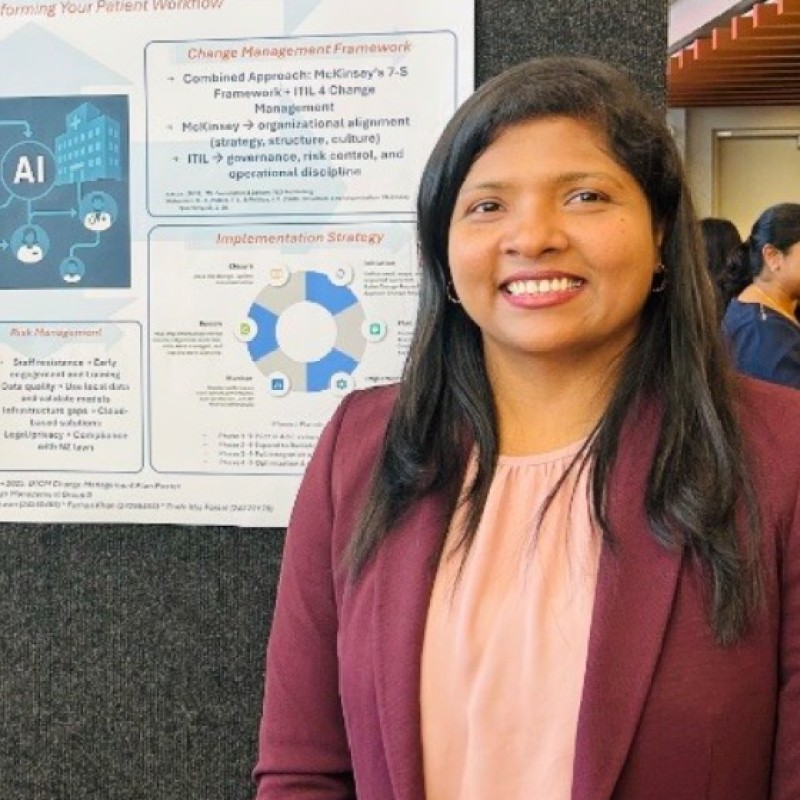
Thafnitha Faisal and Daniel Vaipulu
Abstract
This study examines how data-analytics methods can enable data-driven decision-making in IT project portfolio management (ITPPM) using the Disciplined Agile Delivery (DAD) portfolio process blade as the organising lens. Through a multivocal literature review that integrates peer-reviewed and credible grey literature, the research addresses three linked questions: RQ1.1 What challenges inhibit data-driven decision-making in ITPPM; RQ1.2 Which data-analytics methods are reported for ITPPM; and RQ1 What are the benefits and success factors when analytics methods are integrated into portfolio practices. Findings show recurring barriers across DAD practices, led by poor data quality and integration, immature governance and PMO alignment, tooling and capability gaps, unreliable intake scoring, limited portfolio risk telemetry, and weaknesses in financial and operational measurement. To operationalise these insights, the study proposes a three-layer conceptual framework (DAD practices → analytics methods → benefits & success factors) that serves as a guide for leaders to sequence interventions: establish data and governance foundations, pilot targeted analytics, then institutionalise successful patterns. The paper concludes with practical roadmaps and research directions to validate the framework empirically
Agile Adoption: A New Zealand Case Study

Tauqeer Bilal
Abstract
The evolving business environment and increasing market pressures have significantly transformed the nature of project management. Organisations are under constant pressure to deliver faster and more effective solutions, driving the adoption of Agile software development. To remain competitive in the global market, software companies must integrate efficiency, flexibility, and quality into their development practices. Agile methodologies offer potential benefits such as reduced development time, improved quality, increased productivity, and cost-effectiveness. Despite its advantages, successful Agile adoption remains challenging, and many organisations struggle to achieve their intended outcomes. Misconceptions, such as adopting Agile merely as a trend or assuming its success in other contexts guarantees similar results, can hinder implementation. A clear understanding of Agile principles and alignment with organisational context is critical for effective adoption. This study presents a case analysis of a New Zealand–based company that successfully implemented Agile practices. Data was collected through four semi-structured interviews. The research highlights key success factors, challenges faced during the adoption process, and the outcomes achieved. Findings demonstrate that Agile adoption can enhance productivity, accelerate delivery, and improve customer satisfaction when aligned with organisational objectives and context.
Critical Factors Influencing the Adoption of Basic and Scaled Agile Methods: A Comparative Study

Yinghui (Michael) Zhang and Ramesh Lal
Abstract
This paper presents a systematic literature review (SLR) of 44 primary studies to critically investigate the factors influencing the adoption of six major Agile methods, segmented into two categories: Basic (XP, Scrum, Kanban) and Scaled (SAFe, DAD, LeSS). The analysis identifies key success factors (nine for Basic, eight for Scaled) and corresponding barriers. Findings confirm that top management support, effective communication, and training are fundamental enablers across both levels. Crucially, the study provides a comparative synthesis that distinguishes their focus: Basic Agile mitigates internal team process risks, while Scaled Agile addresses systemic coordination and enterprise governance challenges. Furthermore, we map the limitations and strengths of these methods onto Software Project Risk Quadrants, demonstrating that scaling is necessary to effectively manage Execution and Environmental Risks. This research offers crucial theoretical insights for balancing flexibility and structure in complex Agile transformations.